
The ‘Flexible Infrastructure’ pilot project moves into its next phase – temporary river training structure in use during the current low-water period
The drought that affected the Danube in the first half of 2026 once again highlights how important it is to adapt river structures innovatively and flexibly to climate change for the future of the waterway. In order to gain new findings for the further development of dynamic elements in river basin management, viadonau is continuing the ‘Flexible Infrastructure’ pilot project east of Vienna with undiminished vigour this year as well. On 20 April, a loaded barge was once again positioned outside the navigation channel on the right bank of the Danube in the area of the “Rote Werd” ford (between river km 1897.3 and 1897.2) and secured with a bow anchor and three 1.5-tonne d’Hone special anchors.
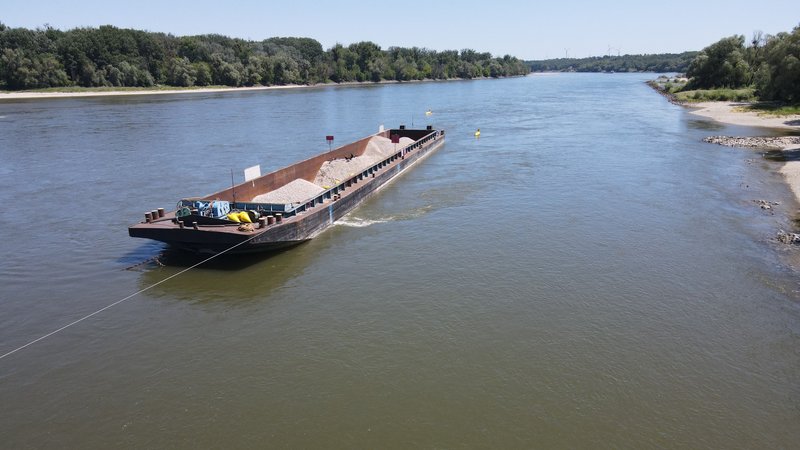
Drone flight over the project site at "Rote Werd", photo: © viadonau
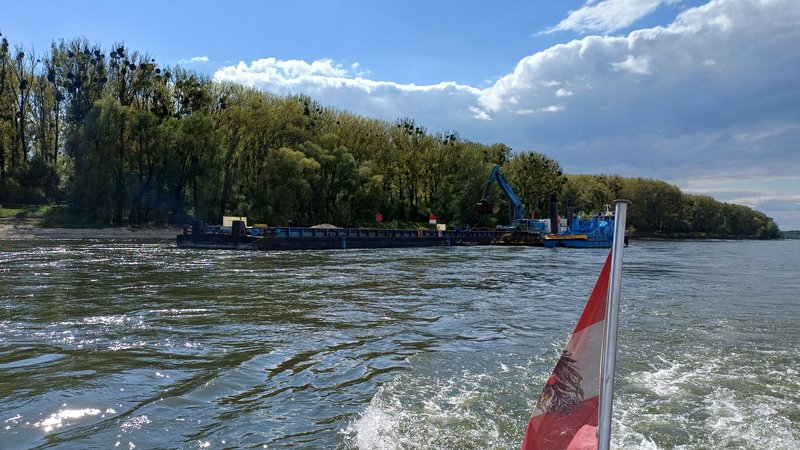
Positioning of the barge with a dredging pontoon, photo: © viadonau
Whilst the precisely positioned barges are monitored through regular on-site checks and via GPS trackers, the project area is being precisely surveyed using a multibeam echo sounder. At the same time, scientists from the University of Natural Resources and Life Sciences, Vienna (BOKU) are supporting the project. This involves carrying out ADCP measurements and creating a so-called ‘digital twin’. In this way, morphological changes are to be reconstructed in future using 3D modelling, enabling deployment scenarios for the flexible infrastructure elements to be planned, evaluated and compared with even greater foresight.
The pilot project also aims to clarify the influence of various test parameters, such as the angle of attack or the number of barges, on the effects within the navigation channel (mobile river training structure). On 19 May, the hydraulic engineering company Felbermayr therefore increased the angle of attack of the barge with the support of the Hainburg Shipping Authority.
The project is being carried out as part of the FAIRway Danube II project and is co-financed by the European Union’s Connecting Europe Facility (CEF). Furthermore, similar pilot trials are currently being conducted in the Danube countries of Croatia, Romania and Bulgaria. The exchange of knowledge and experience between the countries enables even more targeted planning of further similar trials.
