
Raising awareness of business locations along the Danube in Vienna – an expert workshop by viadonau and the Port of Vienna
Direct access to the waterway offers significant strategic advantages for companies, such as a wide range of logistical synergies. With its port Vienna is an established business hub that plays a central role - not only in freight shipping and logistics, but also in the booming passenger shipping sector and other spheres. Following an informative technical visit at the Port of Vienna, the second workshop of the viadonau initiative on 13 May at thinkport VIENNA brought together more than 30 experts from business, infrastructure and energy supply.

Workshop, thinkport VIENNA, photo: © viadonau
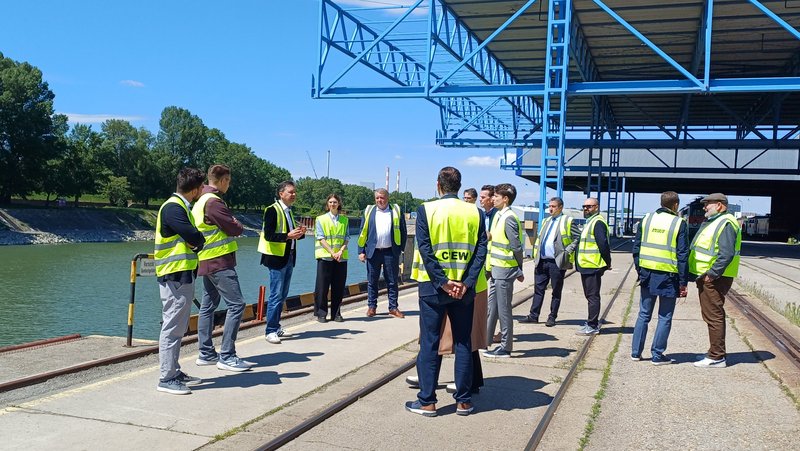
Technical visit at Port of Vienna, photo: © viadonau
Fritz Lehr, Managing Director of the Port of Vienna, and Hans-Peter Hasenbichler, Managing Director of viadonau, opened the event and set the scene: What advantages does setting up a business along the Danube – and in what direction is the sector heading? Prior to this, participants had already gained fascinating insights into on-site operational processes during the Technical Visit in the port.
Bettina Matzner from viadonau provided a detailed overview of the benefits of waterfront access and current developments. Jan Riepl from the Vienna Business Agency added an international perspective and praised the workshop as a successful tool for raising awareness. In their presentations on property development, Harald Beutl from viadonau and Michael Hefelle from the Port of Vienna provided comprehensive insights into the development and marketing of properties. The topic of waterfront living was of particular interest to the audience, whilst Hefelle outlined tangible prospects for potential new businesses by presenting the current site plan and available open spaces within the port.
Specific insights from the business world provided a direct link to real-world practice. Thomas Bogler, Managing Director of Viking River Cruises, outlined his company’s operational requirements and highlighted the increased need for berths and storage space during the winter months. Christoph Caspar from Donauraum Wien reported on encouraging developments in passenger shipping: Passenger numbers have not only recovered following the COVID-19 pandemic but are currently reaching all-time highs. Richard Hohenbichler from Wien Energie highlighted shore power as a key element of sustainable port development: green electricity is already being used at the sites Reichsbrücke and Freudenau, significantly reducing noise and air emissions. Peter Rojko from the Port of Vienna presented the port’s sustainability strategy and Jan-Martin Kusztrich from OMV emphasised the strategic importance of waterways for the safe transport of crude oil.
The concluding panel discussion focused primarily on alternative fuels and the energy transition in shipping. Geopolitical developments and their impact on crude oil prices, as well as the growing importance of electric mobility in heavy goods transport, were furthermore discussed.
Flexibility, cooperation and cross-sector thinking were highlighted as key factors for future success – aspects demonstrated by the workshop itself.
