
Towards a Sustainable Future on the Danube – Innovation and New Opportunities for the Waterway at viadonau’s Danube Business Talks
Smart, competitive and resilient. Through a comprehensive set of measures, the Danube countries aim to future-proof the waterway and position the river as effectively as possible within a changing European transport network. At the Danube Business Talks, organised by viadonau on June 11th at the Austrian Federal Economic Chamber (WKÖ), around 170 industry experts gathered under the motto “Navigating Change – Towards a Sustainable Future” to explore the shared path towards the waterway of tomorrow. Renowned experts from economic backgrounds, inland navigation and waterway administration provided first-hand insights, current assessments and innovative solutions.
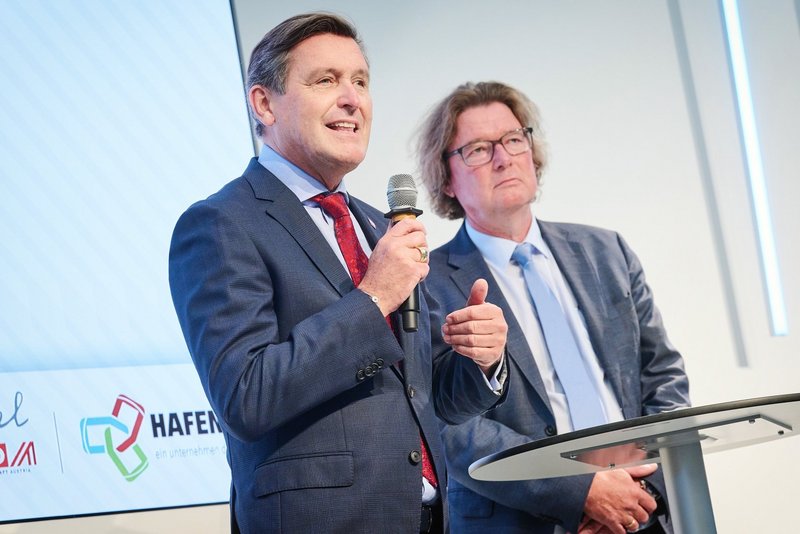
Federal Minister Peter Hanke (BMIMI) and viadonau Managing Director Hans-Peter Hasenbichler welcome participants to the Danube Business Talks 2026 at the Austrian Federal Economic Chamber (WKÖ) in Vienna. Photo: © viadonau/Johannes Zinner
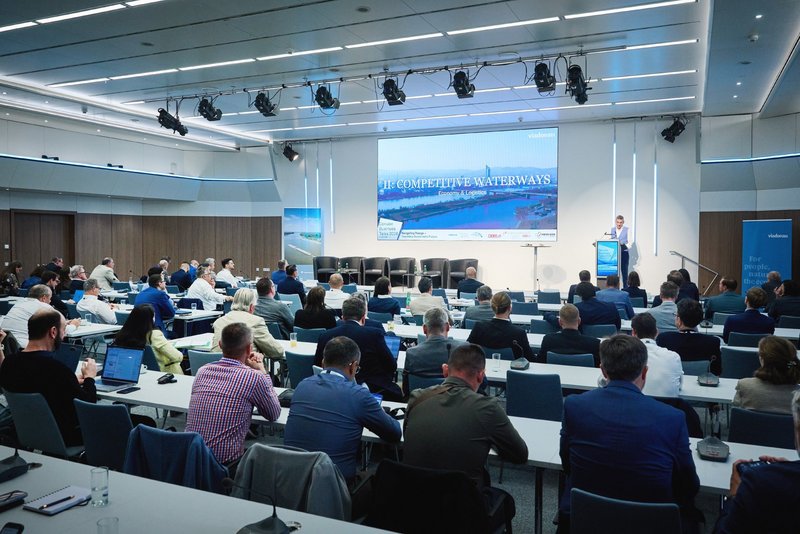
Well attended! Around 170 experts from across the inland navigation sector gathered in Vienna for the popular Danube conference. Antonio Stoean of Pro Danube International skilfully and engagingly moderated the event. Photo: © viadonau/Johannes Zinner
As Europe advances its transport transition, alternative solutions for a more sustainable multimodal transport network are becoming increasingly important. Compared to other modes of transport, the advantages of inland waterways are clear: if the aim is to reduce road congestion, significantly cut emissions and strengthen transport capacity without further land take, the Danube is a key asset. The importance of joint action by policymakers and the Danube countries for the future of the waterway was already highlighted during the opening discussion of the conference, between Peter Hanke, Federal Minister for Innovation, Mobility and Infrastructure (BMIMI), and viadonau Managing Director Hans-Peter Hasenbichler.
One thing is certain: while inland navigation has long been a frontrunner in terms of environmental performance and transport capacity, its infrastructure, reliability and resilience must continue to be optimised. Only then can lasting incentives be created for industry and the Danube firmly established as an attractive alternative within Europe’s future transport network. Concepts, ideas and innovative approaches are already available and are being implemented through numerous projects focusing on the greening of inland navigation, tailored Danube logistics solutions and modern infrastructure.
Furthermore, as moderator Antonio Stoean of Pro Danube International repeatedly emphasised, now is precisely the time to maintain a strong common course, as climate change and the international security situation continue to place increasing pressure on inland navigation.
Driving Down Emissions Through Innovation – Modernising Fleets for the Future
Modern development in the mobility sector begins with the sustainable reduction of greenhouse gas emissions. Along a natural transport corridor connecting ten countries, effective strategies and solutions can only be developed through cross-border cooperation. According to Martin Quispel of the Expertise and Innovation Centre for Inland Barging (EICB), different national framework conditions must also be taken into account. For Quispel, sustainable innovation is therefore not primarily a question of technology, but of economic feasibility for individual countries and fleets.
While full electrification of inland navigation is currently of limited practical relevance, clear regulatory frameworks and appropriate carbon pricing could deliver short- and medium-term improvements on the fuel side. The most promising candidates are hydrotreated vegetable oil (HVO100), which requires neither new infrastructure nor new propulsion technology, as well as methanol and biomethane. However, those would require new vessel concepts, retrofit measures and suitable bunkering infrastructure.
According to Quispel, the foundations for modernising European inland navigation have been firmly established for many years and continue to evolve dynamically. Key initiatives include the platform for implementing green shipping innovations, PLATINA4Action, as well as projects such as FAIRway Danube II, COMEX2, DiVINE and SYNERGETICS.
Incidentally, the Innovation Action SYNERGETICS has spent recent years investigating the practical challenges associated with operating vessels powered by alternative fuels and implementing corresponding retrofit measures. These assessments were carried out under real-life operating conditions using several vessels, including viadonau’s push boat Bad Deutsch-Altenburg. Benjamin Friedhoff of the German Development Centre for Ship Technology and Transport Systems (DST) is convinced of the value of the project’s scientifically monitored field trials. The resulting data and operational experience provide an important basis for decision-making across the inland navigation sector and demonstrate what is already achievable with existing fleets today.
Emissions Reporting and Smart Navigation Assistance for Greater Efficiency
While zero-emission targets are high on the agenda throughout the transport sector, in order to make meaningful progress it is equally important to understand where the industry currently stands. According to Leonie Morsch, Sustainability Manager at Rhenus Port Logistics, collecting emissions data on inland waterways is particularly challenging due to the dynamic conditions of river transport, yet it is indispensable for establishing a reliable and meaningful data basis.
According to her, emissions reporting increases transparency, supports compliance with key requirements in global supply chains, strengthens trust among customers and stakeholders, and is increasingly being requested by both. The main obstacles are currently methodological in nature. Examples include bunkering voyages carried out outside regular transport operations or empty runs. Although emissions are generated during such voyages, they are not systematically captured within tonne-kilometre calculations. In addition, she explains that highly complex datasets are collected under varying operating conditions and from different vessel types, making reliable evaluation difficult. Consequently, Transport Management Systems (TMS) must continue to evolve in order to ensure data completeness and comparability.
Digital solutions are increasingly finding their way into inland navigation operations, enabling not only higher fuel efficiency but also enhanced operational safety. For Evert Bulcke, digitalisation expert at Tresco Group, smart control electronics and software solutions that directly support vessel masters at the helm are already providing a significant modernisation boost. The key word is automation, as he explains. Through precise automatic route tracking and highly accurate real-time feedback, the TrackPilot (TGAIN) electronic steering and navigation support system can help reduce fuel consumption and lower accident risks. Given the often limited manoeuvring space on inland waterways, occasionally dense traffic conditions and the resulting stress levels for crews, such automation solutions offer considerable modernisation potential, according to Bulcke. Tresco has already equipped around 1,000 vessels with these technologies.
Quo Vadis Inland Waterway Transport?
Navigating the Crisis with Traditional Strengths and New Opportunities
For many years, annual transport statistics on the Danube have painted a mixed picture. While passenger shipping continues to enjoy growing popularity, freight transport appears to be operating with the handbrake on.
During the panel discussions on competitiveness and resilience, participants largely agreed on the main reasons for this development: climate change, the international security situation and the need for stronger incentive frameworks. More frequent drought periods and the resulting low-water conditions are making the economically viable use of the waterway increasingly uncertain, as sufficient loading depths for cargo vessels can no longer be taken for granted. This makes proactive and modern fairway maintenance by the Danube countries all the more important.
At the same time, closer integration between industry and the waterway is needed. According to Herbert Pribitzer, adviser to the coordinator for the Rhine-Danube Corridor, there is much that can be learned from the Rhine. Danube ports must become more deeply embedded in industrial supply chains and develop into integral components of manufacturing and assembly processes. This would make onward transport of vehicles, large machinery and other goods via the Danube particularly attractive.
As Ralf Jina of DDSG Mahart pointed out, the conflict in the Persian Gulf has at least temporarily eroded one of inland navigation’s key competitive advantages – lower fuel costs. Nevertheless, for Pribitzer, the transport of high-and-heavy cargo remains one of the strongest arguments in favour of the waterway.
Climate change has demonstrated for many years that crises can fundamentally shift the focus of policymakers and businesses alike. New necessities emerge, while previously overlooked perspectives gain importance. At the Danube Business Talks, David Bachmann from ADVANTAGE AUSTRIA Kyiv provided compelling insights into the everyday realities of a country affected by war, yet steadfastly committed to maintaining its economic strength.
Since the outbreak of the war in Ukraine, Europe’s security landscape has been fundamentally reassessed. Beyond serving as a vital supply route, what role can the Danube play as a strategically important transport corridor for security and defence?
For Ines Poppinger, Young Professional at viadonau, it is precisely the traditional strengths of inland waterways—the enormous transport capacities of inland vessels and the inherent robustness of the transport mode—that make them particularly well suited for military transport purposes. The idea of strengthening the Danube’s role not only for civilian but also for military transport forms the core of the “Dual-Use” strategy presented by Birgit Kobierski (BMIMI) under the EU’s Connecting Europe Facility (CEF) funding programme.
As Kobierski explained, ports play a key role in this context. Their multimodal infrastructure makes them ideal hubs and distribution centres for military transport operations. The Danube is therefore not merely a “nice-to-have” option, but should be regarded as an additional and resilient transport corridor in times of crisis and integrated as an important component of Europe’s security and defence strategy.
Europe and the Danube Community Gathering in Vienna
Every two years, the Danube Business Talks serve as a major meeting point for a diverse and steadily growing European expert community. This year, partners from numerous international Danube projects—from the Netherlands to the Black Sea region—once again answered the call to Vienna. Representatives of the SYNERGETICS project, which is coming to a close this year, as well as the FAIRway Danube II project, running since 2023, came together at the event to exchange knowledge and experiences. In addition to attending a wide range of thematic sessions, participants once again made active use of the business dating format to establish new contacts, exchange fresh ideas and stay informed about the latest developments in the Danube economy. It is hardly surprising: a shared commitment to the Danube and a common ambition to strengthen the waterway beyond national borders define the spirit of the Danube Business Talks—a spirit that once again made a strong impression in Austria’s capital city.
The Danube Business Talks 2026, organised by viadonau, were supported by ADVANTAGE AUSTRIA and the Port of Vienna.
Visit our Photo Gallery Danube Business Talks 2026
Presentation download (PDF)
Smart Waterways: Innovation & Sustainability
IWT – Challenges and Hope (Benjamin Friedhoff, DST)
1,000 Ships Equipped with TGAIN (Evert Bulcke, Tresco Group)
Emission Reporting from the Perspective of a Major Shipping Company (Leonie Morsch, Rhenus Port Logistics)
Platina 4 Action (Martin Quispel, EICB)
Resilient Waterways: Military Mobility/Reliable Waterway Infrastructure
Military Mobility (Ines Poppinger, viadonau)
Dual Use in CEF Transport (Birgit Kobierski, Austrian Federal Ministry for Innovation, Mobility and Infrastructure)
